
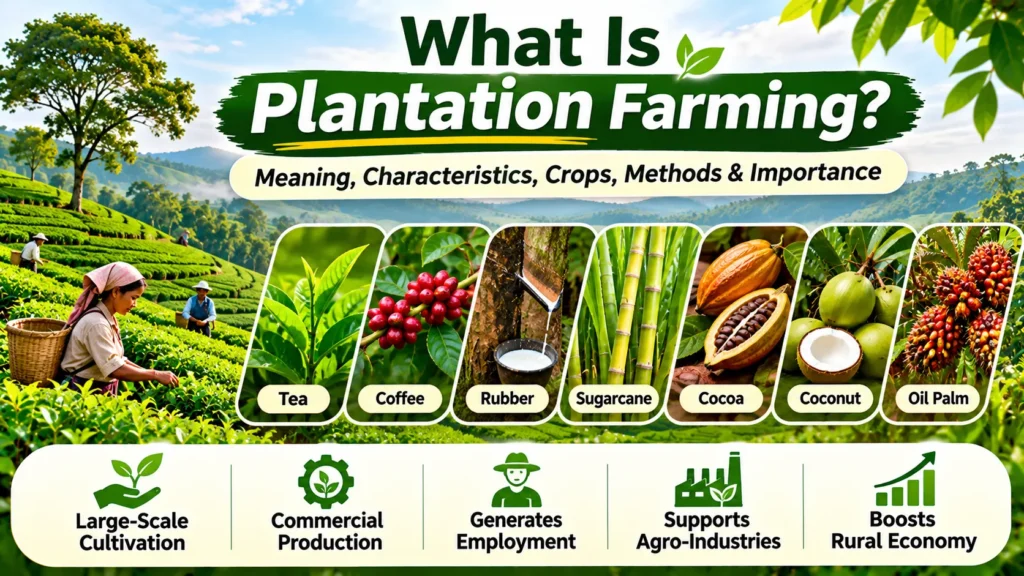
What Is Plantation Farming?
Plantation farming is a type of commercial agriculture in which a single crop or a limited number of crops are cultivated on a large area of land, usually for sale and industrial processing. It generally involves organized farming practices, significant investment, hired labor, and modern agricultural techniques to achieve high productivity.
Plantation agriculture is commonly practiced in tropical and subtropical regions where the climate, rainfall, soil conditions, and temperature are suitable for growing specific commercial crops. Some of the most common plantation crops include tea, coffee, rubber, sugarcane, cocoa, coconut, and oil palm.
Unlike subsistence farming, where the crops are grown for your own consumption, plantation farming is all about producing agricultural commodities for the domestic market, for industry, and for export.
What Are the Main Characteristics of Plantation Farming?
Plantation farming has a number of very distinct characteristics which set it apart from all other forms of farming.
- Large-Scale Cultivation
Plantation agriculture is the cultivation of crops over large areas of land. The size of the plantation can vary enormously from one location to another, with some covering hundreds of hectares and others thousands.
- Commercial Production
The primary objective of plantation farming is to produce crops for commercial purposes. The harvested produce is sold in domestic and international markets or supplied to processing industries.
- Specialisation in Crops
Plantations are generally single crop operations (tea, coffee, rubber, etc.) and so you end up with a very high degree of specialization in the management of that crop, in the harvesting of that crop and in the processing of that crop.
- Labour-Intensive Operations
Plantation farming requires labor for all the activities from land prep through to planting, irrigation, pruning, harvesting, sorting and packaging. Whilst machinery is used in many of the operations, there is still a significant amount of manual labor required for a number of plantation crops.
- Processing and Transportation Facilities
Many of the plantation crops require processing very soon after harvest, so the plantations are invariably supported by factories, processing units, warehouses and transport facilities in the vicinity.
- Long-Term Agricultural Investment
Several plantation crops, including tea, coffee, and rubber, are perennial crops. They require considerable initial investment and take time to reach commercial production levels.
WHICH CROPS ARE GROWN THROUGH PLANTATION FARMING?
Plantation farming is particularly common in regions with warm temperatures and suitable rainfall. Some of its major crops include:
- Tea
Tea is one of the most widely cultivated plantation crops. It grows well in regions with adequate rainfall, humid conditions, and well-drained soil. India, China, Sri Lanka, and Kenya are important tea-producing countries.
- Coffee
Coffee is grown commercially in the tropics and subtropics and will generally need the right temperatures, sufficient rainfall, and good drainage. The big coffee-producing countries are Brazil, Vietnam, Colombia, and India.
- Rubber
Natural rubber is obtained from the latex of rubber trees. It is an important industrial raw material used in manufacturing tires, footwear, medical products, and various rubber-based goods. Thailand, Indonesia, and India are important rubber-producing countries.
- Sugarcane
Sugarcane is a major commercial crop, used for sugar, jaggery, ethanol, and a range of other industrial products. It’s a crop which requires a fairly long growing season and a good deal of water.
- Cocoa
Cocoa is grown in the humid tropics, and the beans are used to make chocolate, cocoa powder and cocoa butter. Côte d’Ivoire and Ghana are the two leading producers of cocoa.
- Coconut
Coconut plantations are commonly found in tropical coastal regions. Different parts of the coconut palm are used to produce coconut oil, food products, coir, and other commercial goods.
- Oil Palm
Oil palm is grown commercially for its fruit, which is then processed to produce palm oil. The oil is used in food manufacture, in cosmetics and in a variety of personal care products as well as in a number of industrial applications.
What Are the Different Methods of Plantation Farming?
Planting involves a number of different farming methods to keep the crop healthy, get the best yield, and manage the resources effectively.
- Monoculture Farming
Monoculture is the practice of growing a single crop on the same agricultural land. It’s, of course, the practice most associated with plantation agriculture, as it allows for specialized crop management, harvesting, and processing.
However, continuous monoculture can increase the risk of pest outbreaks, soil nutrient depletion, and crop diseases if appropriate management practices are not followed.
- Scientific Land Preparation
Before planting, the land is prepared by clearing, plowing, leveling, and soil testing. Good land prep will lead to better root development, better water management, and better establishment of the crop.
- Irrigation and Water Management
Water management is key to maintaining plantation productivity. The method of water management will vary depending on the crop and the local situation, with drip irrigation, sprinkler irrigation and various other water management techniques being used.
Drip irrigation is of course very useful in water conservation areas as it delivers the water directly to the root zone.
- Fertiliser and Nutrient Management
Plantation crops need the essential nutrients for healthy growth, and farmers will use organic manure, compost, and chemical fertilizers as appropriate depending on the soil and the crop.
Soil testing helps determine nutrient deficiencies and supports more balanced fertilizer application.
- Integrated Pest Management(IPM)
Integrated Pest Management involves combining biological, cultural, mechanical, and carefully selected chemical methods to control pests and diseases.
This approach helps to reduce the amount of pesticide that would otherwise be used, whilst at the same time protecting the health of the crop and the surrounding environment.
- Pruning and Crop Maintenance
Pruning is the act of removing selected branches, shoots, or other unwanted growth to maintain the shape and health of the crop. It’s of particular importance in tea, coffee, and other plantation crops.
Regular maintenance also includes weeding, mulching, soil conservation, and monitoring plant health.
- Mechanisation and Modern Technology
Modern plantations increasingly use agricultural machinery and technology for activities such as land preparation, spraying, harvesting, transportation, and monitoring.
Digital tools, remote sensing, and precision agriculture can also help plantation managers monitor crop conditions and improve resource efficiency.
Economic Importance of Plantation Farming
Plantation farming plays an important role in the economic development of several agricultural regions. Its contribution extends beyond crop production and supports multiple industries.
- Employment Generation
Plantations create employment in all areas of the operation, from planting and harvesting through to processing, packaging, transport and marketing. They provide employment for agricultural workers and the rural communities.
- Contribution to International Trade
Crops such as tea, coffee, rubber, cocoa and palm oil are major internationally traded agricultural commodities. They are a major source of foreign exchange and underpin the agricultural trade sector.
- Development of Agro-Based Industries
Plantation crops are the source of raw materials for a number of industries. Sugarcane is the source of raw material for the sugar and ethanol industries. Rubber is used in the manufacture of tires. Tea and coffee are the raw materials for the beverage processing industries.
- Rural Infrastructure Development
Large plantation operations can encourage the development of roads, storage facilities, processing units, transportation networks, and other infrastructure in rural areas.
- Income Generation for Farmers and Businesses
Commercial plantation agriculture can be a source of income for the landowner, the grower, the workers, the processor, the exporter, and all the other businesses that are part of the agricultural supply chain.
- Growth of the Food and Beverage Sector
Crops such as tea, coffee, cocoa, coconut and sugarcane are key raw materials for the food and beverage industry and their cultivation underpins the manufacture, the retail and a whole host of other businesses.
Plantation Farming in India
India has favorable climatic and geographical conditions for cultivating several plantation crops. The country’s diverse agricultural regions support the production of tea, coffee, rubber, coconut, and other commercial crops.
Some important plantation-growing regions in India include:
- Tea: Assam, West Bengal, Tamil Nadu, and Kerala.
- Coffee: Karnataka, Kerala, and Tamil Nadu.
- Rubber: Kerala, Tripura, and other parts of northeastern India.
- Coconut: Kerala, Tamil Nadu, Karnataka, and Andhra Pradesh.
- Oil Palm: Andhra Pradesh, Telangana, and other suitable regions.
- Cocoa: Andhra Pradesh, Kerala, Karnataka, and Tamil Nadu.
Plantation agriculture contributes to India’s agricultural economy by supporting employment, agro-processing, exports, and rural livelihoods.
Challenges Associated with Plantation Farming
- Climate Change: Changes in rainfall patterns, increasing temperatures, droughts, and extreme weather events will all have an impact on crop yields and plantation productivity.
- Soil Degradation: Growing the same crop continuously without any soil management can result in soil nutrient depletion, erosion, and declining soil quality.
- Pest and Disease Outbreaks: Large areas of a single crop are susceptible to widespread pest and disease outbreaks.
- Labour Shortages: Many plantation operations depend on manual labor. Labor shortages, rising wages, and difficult working conditions can affect production costs.
- Market Price Fluctuations: International demand, supply conditions, trade policies, and changing commodity prices can influence plantation farmers’ incomes.
- Environmental Concerns: Poorly managed plantations can lead to deforestation, loss of biodiversity, excessive use of water, and pollution through the use of chemicals.
Promoting sustainable agriculture, better labor conditions, more diverse farming systems, and climate-resilient technologies can all help to deal with these issues.
Conclusion
Plantation farming is an important form of commercial agriculture that supports agricultural production, industrial development, employment generation, and international trade. Crops such as tea, coffee, rubber, cocoa, coconut, and sugarcane provide essential raw materials for several industries while contributing to rural economic growth.
The long-term success of plantation agriculture will, of course, depend on responsible land management, efficient use of water, soil conservation, fair labor practices, and sustainable crop production. It can continue to be a significant contributor to economic development as long as it is done in a way that minimizes its impact on the environment, by combining traditional agricultural knowledge with modern farming technology.