
Intercropping Vs Crop Rotation
Modern agriculture is all about a number of different farming practices that are designed to improve crop productivity, maintain soil fertility, and use the resources available to the farmer as efficiently as possible. Two of the key agricultural techniques in this respect are intercropping and crop rotation.
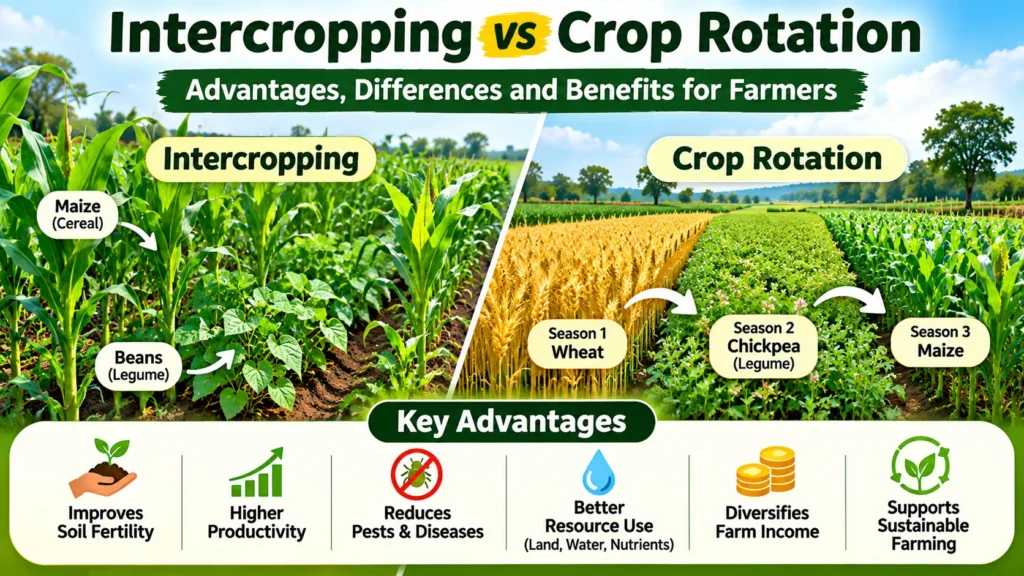
Both of these methods involve growing different crops on the same bit of agricultural land. Intercropping is where you grow two or more crops together in the same field in the same season. Crop rotation is where you grow different crops on the same land in a planned sequence over successive seasons or years.
Understanding the difference between intercropping and crop rotation will enable the farmer to select the appropriate system for their particular soil, climate, water availability and economic requirements.
What Is Intercropping?
Intercropping is an agricultural practice in which two or more crops are cultivated simultaneously on the same piece of land. The crops are usually arranged in specific rows, strips, or patterns to make better use of available resources such as sunlight, water, nutrients, and space.
For instance, farmers may grow maize and beans together, with the maize providing the structural support for the beans to climb on and the beans in turn being able to fix nitrogen in the soil biologically (if the right conditions and the right root-nodulating bacteria are present).
Other common examples include:
- Maize and cowpea
- Sugarcane and potato
- Sorghum and pigeon pea
- Groundnut and sunflower
- Millet and pulses
Advantages of Intercropping
1. Better Utilisation of Resources
Intercropping allows farmers to use available land, sunlight, water, and nutrients more efficiently. Crops with different growth patterns and root systems can utilize resources from different layers of soil.
2. Improved Soil Fertility
Growing legumes (beans, peas, cowpeas, etc.) with other crops can contribute to soil nitrogen via biological nitrogen fixation, and under the right circumstances, this could reduce the requirement for further nitrogen fertilizer.
3. Reduced Pest and Disease Risks
Crop diversity can make it harder for some pests to spread rapidly across a field. Some intercrops will also help to break up pest movement and reduce the impact of crop-specific diseases.
4. Higher Overall Land Productivity
When you select compatible crops, intercropping can actually give you more total output from a given area of land than growing the individual crops separately. It’s all down to the crop combinations, the spacing, the level of competition, and the local growing conditions.
5. Additional Income Opportunities
Farmers can harvest and sell a number of crops from the same field. That gives them the opportunity to diversify their agricultural income and reduce their reliance on a single crop.
6. Better Weed Management
Intercropping can help suppress weed growth when crops establish sufficient ground cover and compete effectively for available resources.
What Is Crop Rotation?
Crop rotation is an agricultural practice in which different crops are grown on the same piece of land in a planned sequence over successive growing seasons or years.
Rather than growing the same crop year on year the farmer will rotate the crop from season to season. This helps to maintain the health of the soil, manage the pests and diseases and ultimately leads to better long term productivity of the land.
For example, a farmer may cultivate wheat in one season, followed by a leguminous crop such as chickpea, and then grow maize in a subsequent season.
Other examples of crop rotation include:
- Rice followed by wheat
- Maize followed by soybean
- Wheat followed by chickpea
- Cotton followed by a suitable pulse crop
- Cereals followed by oilseeds
Advantages of Crop Rotation
1. Maintains Soil Fertility
Different crops have different nutrient requirements. Rotating crops helps avoid the continuous removal of the same nutrients from the soil. Including legumes in a rotation can also improve nitrogen availability for subsequent crops.
2. Breaks Pest and Disease Cycles
So many pests and pathogens are associated with specific crops or plant families. You can break their life cycle by simply changing crops. You remove the host plant they are adapted to, and that will break the cycle and reduce the likelihood of them coming back.
3. Improves Soil Structure
Different crops have different root systems. Deep-rooting crops can be of benefit in terms of improving soil structure and accessing nutrients from deeper in the soil. Crops with an extensive fibrous root system can also be of benefit in terms of soil aggregation.
4. Helps Control Weeds
Changing crops brings about a range of differences in sowing times, crop competition, cultivation techniques and weed control methods. This can be of benefit in the management of weeds which are very difficult to control under continuous cultivation of a single crop.
5. Reduces Dependence on Chemical Inputs
A well-planned crop rotation can help reduce the pressure from certain pests, diseases, and weeds. As a result, farmers may require fewer pesticide and herbicide applications in some situations.
6. Supports Sustainable Agriculture
Crop rotation promotes soil conservation, crop diversity, and balanced nutrient management. It can help maintain agricultural productivity over the long term.
Benefits of Intercropping and Crop Rotation for Farmers
Both agricultural practices offer several advantages that can improve farm management and support long-term agricultural sustainability.
1. Increased Agricultural Productivity
Intercropping helps farmers obtain produce from multiple crops within the same growing season. Crop rotation supports long-term soil productivity and can improve the performance of crops grown in subsequent seasons.
2. Diversification of Farm Income
Growing different crops enables the farmer to diversify their output. If one crop is down (poor yields, poor market prices, etc.), then you can fall back on another.
3. Improved Soil Health
Both of those (intercropping and crop rotation) are good for soil management. Intercropping will increase crop diversity and ground cover; crop rotation will balance the use of nutrients and maintain the structure of the soil.
4. Better Management of Agricultural Risks
Weather conditions, pest attacks, diseases, and market fluctuations can affect agricultural production. Growing different crops through intercropping or crop rotation can help reduce farmers’ dependence on a single crop.
5. Reduced Production Costs
Suitable crop combinations and rotations can lead to reductions in certain inputs (fertilizer and pesticide being the prime examples). The extent of the savings will, of course, be dependent on the specific crops chosen, the local conditions and the farm management practices in place.
6. Promotion of Sustainable Farming
Both of these techniques promote crop diversity, efficient use of inputs, and improved soil management. They can be part of a sustainable agricultural system when coupled with appropriate water and nutrient management.
Which Is Better: Intercropping or Crop Rotation?
Intercropping and crop rotation serve different agricultural purposes, so neither method is universally better than the other.
Intercropping may be more suitable for farmers who want to grow multiple crops simultaneously, diversify their harvests, and make efficient use of available land. It is particularly useful when compatible crops with different growth habits and nutrient requirements are selected.
Crop rotation may be more suitable for farmers who want to maintain soil fertility, manage recurring pests and diseases, and improve the long-term productivity of agricultural land.
Farmers can also combine both practices. For example, they may grow maize and legumes together during one season and follow that combination with a different crop or crop mixture in the next season.
The choice should be based on local climate, soil conditions, the resources available, market demand, and the requirements of the crops being grown.
Conclusion
Intercropping and crop rotation are both good practices which can help a farmer make better use of resources, maintain soil health, and promote sustainable crop production. Intercropping is the practice of growing more than one crop together in the same season. Crop rotation is the practice of growing different crops in a planned sequence over successive seasons.
Both of these approaches can be used to diversify farm production, manage risk and improve long-term productivity. The right crops in the right place, combined with a sound farming plan, can lead to a more productive, resilient and sustainable farm system.